Harold Cohen
British
(1928-2016)
Harold Cohen was a pioneering figure in computer art and one of the first artists to treat software as a studio medium. Trained as a painter and once representing the UK at the Venice Biennale, Cohen turned in the late 1960s toward programming as a way to investigate the fundamentals of image-making. In 1973, he began developing AARON, a rule-based drawing system capable of autonomously producing original images. Over the following decades, Cohen refined AARON as both tool and collaborator, using it to explore how a machine could embody artistic decision-making, perception, and mark-making without direct human control.
Cohen’s work sits at the intersection of art history, artificial intelligence, and conceptual practice. Rather than using the computer to execute pre-designed images, he built systems that could generate their own visual logic, raising enduring questions about authorship, creativity, and the nature of artistic intent. His drawings, paintings, and plotter works produced with AARON are held in major museum collections and are widely recognized as foundational to the fields of generative art and computational aesthetics.
AARON
1977-1982
Drawing over lithograph paper
1984
Ink on paper
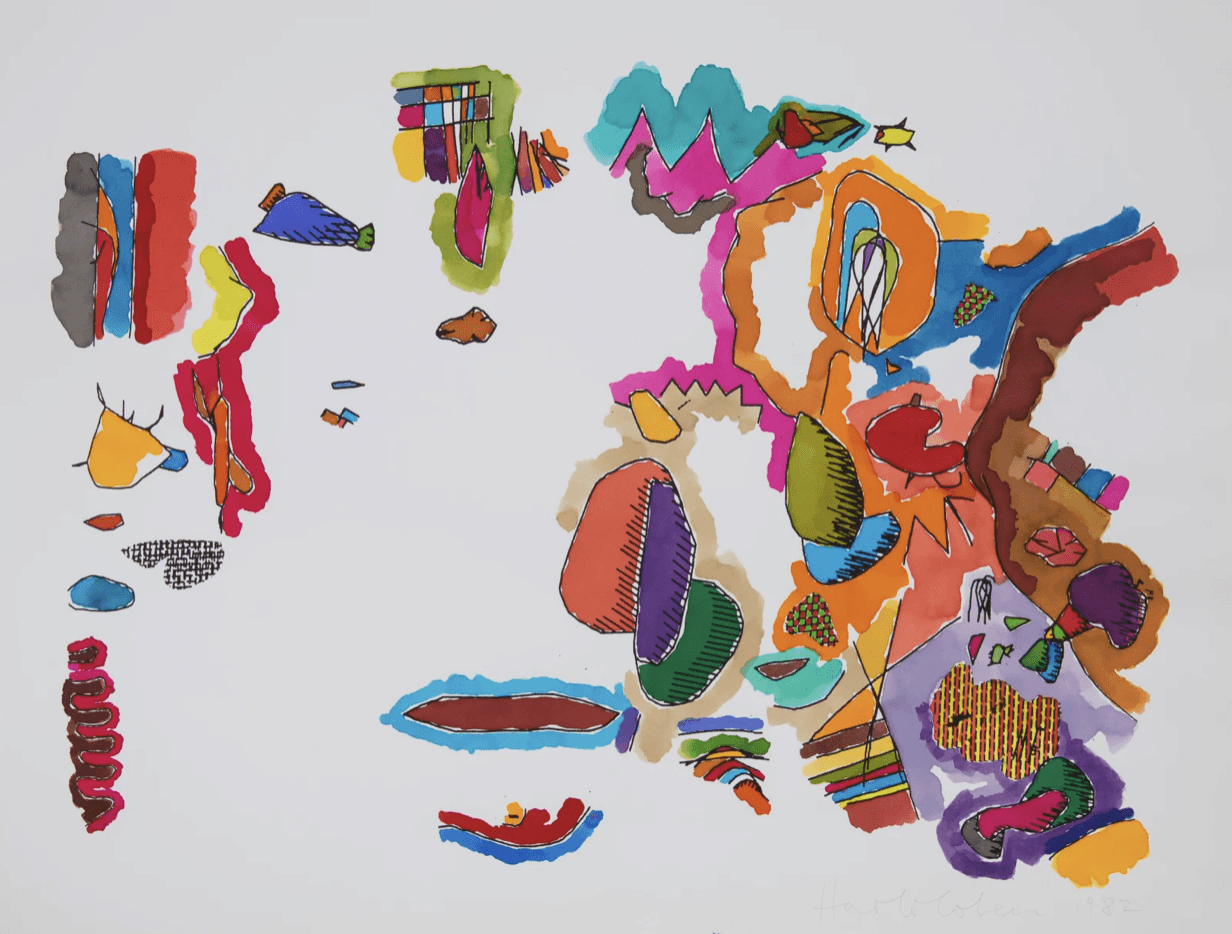
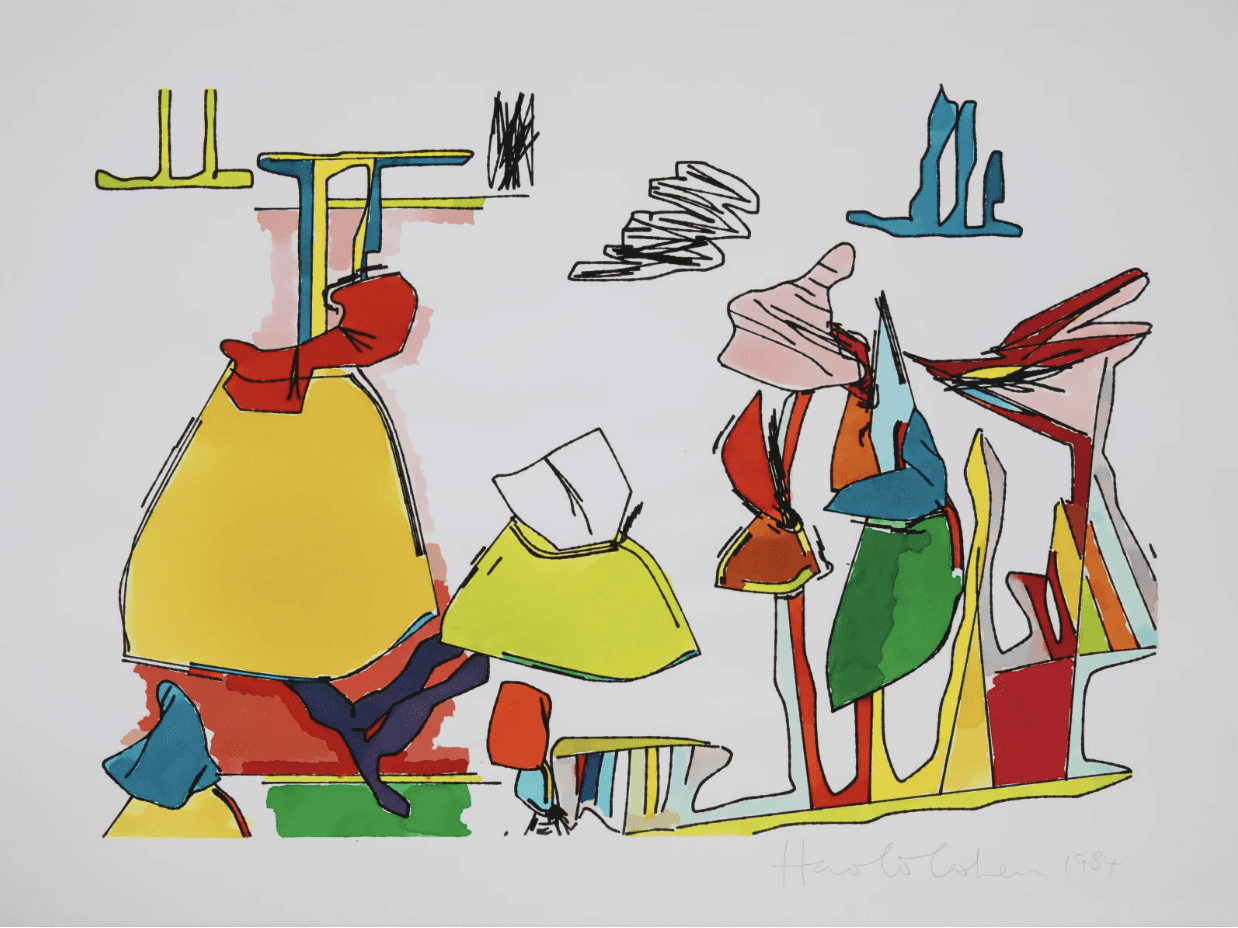
AARON drawings are works generated by the pioneering computer program created by Harold Cohen, one of the earliest artists to explore artificial intelligence as a creative partner. Beginning in the 1970s, Cohen programmed AARON to autonomously construct images using a rule-based understanding of how forms, figures, plants, and spaces can be composed, producing intricate black line drawings that feel intentional yet resist clear representation. In the 1980s, Cohen began hand-coloring select AARON outputs with watercolor, introducing a distinctly human, intuitive layer to the machine’s structural logic.
Harold Cohen
British
(1928-2016)
Harold Cohen was a pioneering figure in computer art and one of the first artists to treat software as a studio medium. Trained as a painter and once representing the UK at the Venice Biennale, Cohen turned in the late 1960s toward programming as a way to investigate the fundamentals of image-making. In 1973, he began developing AARON, a rule-based drawing system capable of autonomously producing original images. Over the following decades, Cohen refined AARON as both tool and collaborator, using it to explore how a machine could embody artistic decision-making, perception, and mark-making without direct human control.
Cohen’s work sits at the intersection of art history, artificial intelligence, and conceptual practice. Rather than using the computer to execute pre-designed images, he built systems that could generate their own visual logic, raising enduring questions about authorship, creativity, and the nature of artistic intent. His drawings, paintings, and plotter works produced with AARON are held in major museum collections and are widely recognized as foundational to the fields of generative art and computational aesthetics.
AARON
1977-1982
Drawing over lithograph paper
1984
Ink on paper
AARON drawings are works generated by the pioneering computer program created by Harold Cohen, one of the earliest artists to explore artificial intelligence as a creative partner. Beginning in the 1970s, Cohen programmed AARON to autonomously construct images using a rule-based understanding of how forms, figures, plants, and spaces can be composed, producing intricate black line drawings that feel intentional yet resist clear representation. In the 1980s, Cohen began hand-coloring select AARON outputs with watercolor, introducing a distinctly human, intuitive layer to the machine’s structural logic.
Harold Cohen
British
(1928-2016)
Harold Cohen was a pioneering figure in computer art and one of the first artists to treat software as a studio medium. Trained as a painter and once representing the UK at the Venice Biennale, Cohen turned in the late 1960s toward programming as a way to investigate the fundamentals of image-making. In 1973, he began developing AARON, a rule-based drawing system capable of autonomously producing original images. Over the following decades, Cohen refined AARON as both tool and collaborator, using it to explore how a machine could embody artistic decision-making, perception, and mark-making without direct human control.
Cohen’s work sits at the intersection of art history, artificial intelligence, and conceptual practice. Rather than using the computer to execute pre-designed images, he built systems that could generate their own visual logic, raising enduring questions about authorship, creativity, and the nature of artistic intent. His drawings, paintings, and plotter works produced with AARON are held in major museum collections and are widely recognized as foundational to the fields of generative art and computational aesthetics.
AARON
1977-1982
Drawing over lithograph paper
1984
Ink on paper
AARON drawings are works generated by the pioneering computer program created by Harold Cohen, one of the earliest artists to explore artificial intelligence as a creative partner. Beginning in the 1970s, Cohen programmed AARON to autonomously construct images using a rule-based understanding of how forms, figures, plants, and spaces can be composed, producing intricate black line drawings that feel intentional yet resist clear representation. In the 1980s, Cohen began hand-coloring select AARON outputs with watercolor, introducing a distinctly human, intuitive layer to the machine’s structural logic.
© 2025 Kanbas. Any images or other visual representations of artworks are © their respective Artist or Estate, unless otherwise noted. All rights reserved.
© 2025 Kanbas. Any images or other visual representations of artworks are © their respective Artist or Estate, unless otherwise noted. All rights reserved.