Manfred Mohr
German
Born 1938
Lives and works in New York, NY
Manfred Mohr is a pioneering figure in the history of computer and generative art and one of the earliest artists to devote his practice exclusively to algorithmic systems. Initially trained as a jazz musician and abstract painter, Mohr made a decisive shift in the late 1960s after encountering early computer graphics research, recognizing computation as a means to extend the logic of abstraction beyond the limits of the hand. Beginning in 1969, he gained access to mainframe computers and pen plotters at research institutions in Paris and later at Bell Labs, where he developed a rigorously conceptual approach to art-making based on programmed rules, permutations, and mathematical structures. His work rejects subjective composition in favor of systems that autonomously generate form, positioning him as a foundational figure in generative art decades before the term entered common usage.
Quark Lines
1970
Computer generated algorithmic pen plotter drawing
Ink on paper
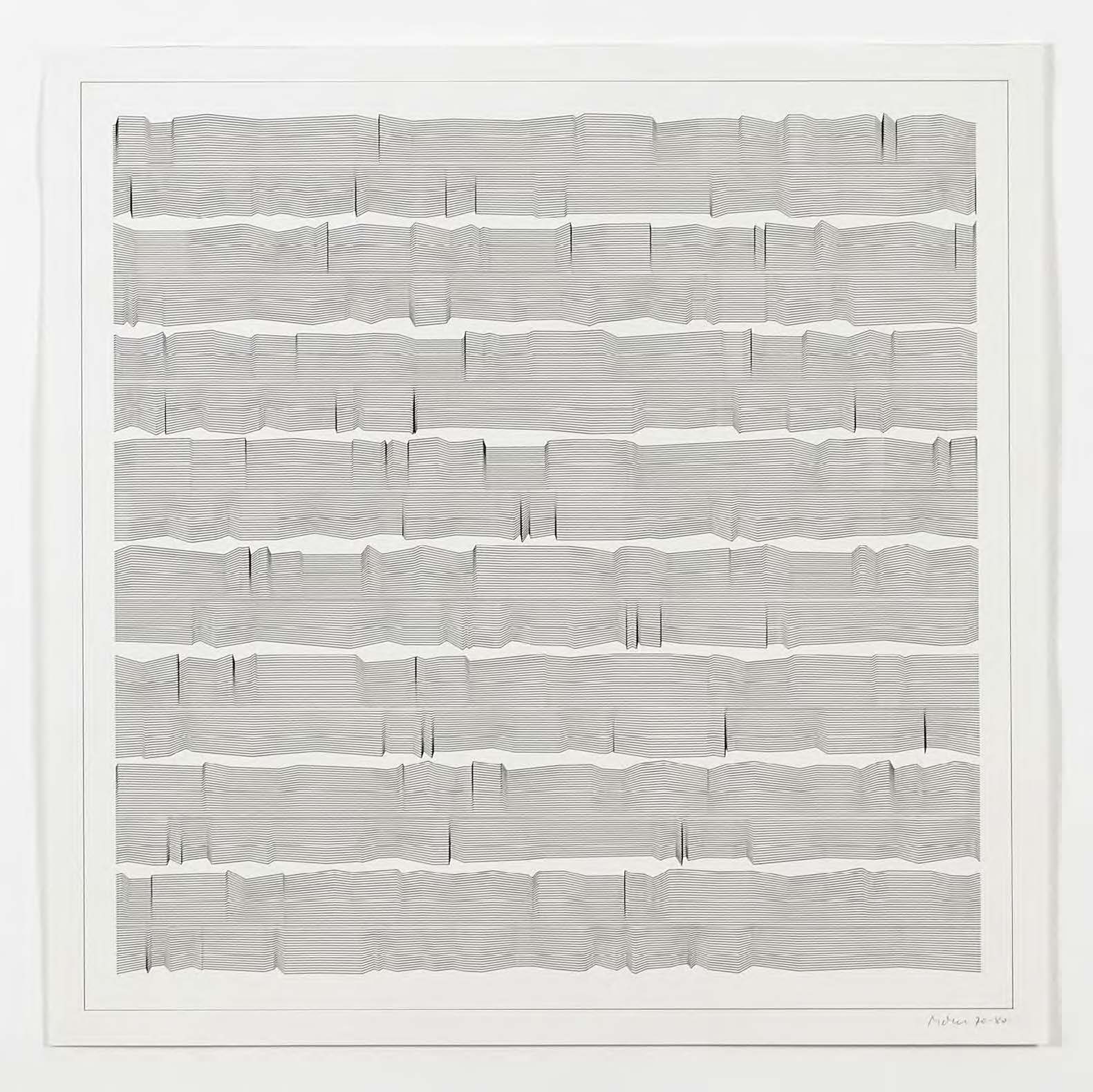
Quark Lines, 1970 – P-052-c belongs to Mohr’s formative period of computer-generated drawing and is part of his early P-series, in which each work is produced entirely through a precisely defined program. Composed of straight-line segments arranged according to algorithmic rules, the work reflects Mohr’s interest in reducing visual language to its most elementary components. The title references “quarks,” the fundamental particles of matter, signaling his conceptual alignment with scientific models of structure rather than representation.
Produced using a mainframe computer and executed via pen plotter, the work exemplifies Mohr’s systematic removal of expressive gesture from the creative process. Every formal decision—line placement, orientation, and density—is determined by code rather than intuition. In doing so, Quark Lines marks a critical moment in the evolution of digital and generative art, foregrounding issues of automation, authorship, and machine agency.
Manfred Mohr
German
Born 1938
Lives and works in New York, NY
Manfred Mohr is a pioneering figure in the history of computer and generative art and one of the earliest artists to devote his practice exclusively to algorithmic systems. Initially trained as a jazz musician and abstract painter, Mohr made a decisive shift in the late 1960s after encountering early computer graphics research, recognizing computation as a means to extend the logic of abstraction beyond the limits of the hand. Beginning in 1969, he gained access to mainframe computers and pen plotters at research institutions in Paris and later at Bell Labs, where he developed a rigorously conceptual approach to art-making based on programmed rules, permutations, and mathematical structures. His work rejects subjective composition in favor of systems that autonomously generate form, positioning him as a foundational figure in generative art decades before the term entered common usage.
Quark Lines
1970
Computer generated algorithmic pen plotter drawing
Ink on paper
Quark Lines, 1970 – P-052-c belongs to Mohr’s formative period of computer-generated drawing and is part of his early P-series, in which each work is produced entirely through a precisely defined program. Composed of straight-line segments arranged according to algorithmic rules, the work reflects Mohr’s interest in reducing visual language to its most elementary components. The title references “quarks,” the fundamental particles of matter, signaling his conceptual alignment with scientific models of structure rather than representation.
Produced using a mainframe computer and executed via pen plotter, the work exemplifies Mohr’s systematic removal of expressive gesture from the creative process. Every formal decision—line placement, orientation, and density—is determined by code rather than intuition. In doing so, Quark Lines marks a critical moment in the evolution of digital and generative art, foregrounding issues of automation, authorship, and machine agency.
Manfred Mohr
German
Born 1938
Lives and works in New York, NY
Manfred Mohr is a pioneering figure in the history of computer and generative art and one of the earliest artists to devote his practice exclusively to algorithmic systems. Initially trained as a jazz musician and abstract painter, Mohr made a decisive shift in the late 1960s after encountering early computer graphics research, recognizing computation as a means to extend the logic of abstraction beyond the limits of the hand. Beginning in 1969, he gained access to mainframe computers and pen plotters at research institutions in Paris and later at Bell Labs, where he developed a rigorously conceptual approach to art-making based on programmed rules, permutations, and mathematical structures. His work rejects subjective composition in favor of systems that autonomously generate form, positioning him as a foundational figure in generative art decades before the term entered common usage.
Quark Lines
1970
Computer generated algorithmic pen plotter drawing
Ink on paper
Quark Lines, 1970 – P-052-c belongs to Mohr’s formative period of computer-generated drawing and is part of his early P-series, in which each work is produced entirely through a precisely defined program. Composed of straight-line segments arranged according to algorithmic rules, the work reflects Mohr’s interest in reducing visual language to its most elementary components. The title references “quarks,” the fundamental particles of matter, signaling his conceptual alignment with scientific models of structure rather than representation.
Produced using a mainframe computer and executed via pen plotter, the work exemplifies Mohr’s systematic removal of expressive gesture from the creative process. Every formal decision—line placement, orientation, and density—is determined by code rather than intuition. In doing so, Quark Lines marks a critical moment in the evolution of digital and generative art, foregrounding issues of automation, authorship, and machine agency.
© 2025 Kanbas. Any images or other visual representations of artworks are © their respective Artist or Estate, unless otherwise noted. All rights reserved.
© 2025 Kanbas. Any images or other visual representations of artworks are © their respective Artist or Estate, unless otherwise noted. All rights reserved.