Waldemar Cordeiro
Brazillian
(1925-1973)
Waldemar Cordeiro was a pioneering Brazilian artist, theorist, and critic whose work laid foundational ground for both Latin American Concrete Art and early computer-generated art. After training in Rome, he returned to São Paulo where he became a central figure in postwar Brazilian modernism. In 1952, he co-founded Grupo Ruptura, helping to establish Concrete Art in Brazil through a rigorous commitment to geometry, rational structure, and systems-based visual language.
In the late 1960s, Cordeiro made a decisive turn toward computation, becoming one of the first artists internationally to work directly with computers as a creative and conceptual medium.
Collaborating with physicist Giorgio Moscati at the University of São Paulo, he used mainframe computers—at a time when such technology was largely inaccessible—to explore image processing, algorithmic transformation, and the translation of visual information into data.
Derivadas de uma Imagem: Transformação em Grau 0
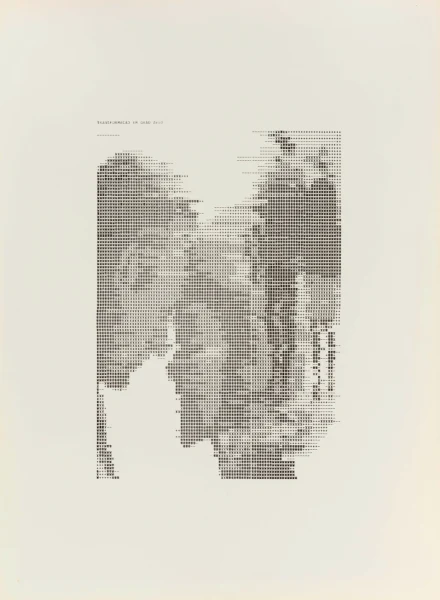
Derivadas de uma Imagem: Transformação em Grau 0 belongs to Cordeiro's late computational period and stands as one of Cordeiro’s most significant digital works. The piece originates from a photographic source image that is subjected to systematic, computer-driven transformations. Through successive reductions, the image is stripped of expressive or representational detail and brought toward what Cordeiro described as “degree zero”: a state in which the image exists primarily as information rather than depiction. Shaped by logic and algorithmic processes rather than gesture, the work exemplifies Cordeiro’s belief in the computer as an aesthetic system, not merely a tool.
Produced using early digital technologies such as punch cards and line printers, the work reflects Cordeiro’s philosophical inquiry into how meaning and perception shift when visual form is mediated by machines. The work was conceived as an edition of 300, though fewer than 300 impressions were ultimately produced, making extant examples relatively rare.
Waldemar Cordeiro
Brazillian
(1925-1973)
Waldemar Cordeiro was a pioneering Brazilian artist, theorist, and critic whose work laid foundational ground for both Latin American Concrete Art and early computer-generated art. After training in Rome, he returned to São Paulo where he became a central figure in postwar Brazilian modernism. In 1952, he co-founded Grupo Ruptura, helping to establish Concrete Art in Brazil through a rigorous commitment to geometry, rational structure, and systems-based visual language.
In the late 1960s, Cordeiro made a decisive turn toward computation, becoming one of the first artists internationally to work directly with computers as a creative and conceptual medium.
Collaborating with physicist Giorgio Moscati at the University of São Paulo, he used mainframe computers—at a time when such technology was largely inaccessible—to explore image processing, algorithmic transformation, and the translation of visual information into data.
Derivadas de uma Imagem: Transformação em Grau 0
Derivadas de uma Imagem: Transformação em Grau 0 belongs to Cordeiro's late computational period and stands as one of Cordeiro’s most significant digital works. The piece originates from a photographic source image that is subjected to systematic, computer-driven transformations. Through successive reductions, the image is stripped of expressive or representational detail and brought toward what Cordeiro described as “degree zero”: a state in which the image exists primarily as information rather than depiction. Shaped by logic and algorithmic processes rather than gesture, the work exemplifies Cordeiro’s belief in the computer as an aesthetic system, not merely a tool.
Produced using early digital technologies such as punch cards and line printers, the work reflects Cordeiro’s philosophical inquiry into how meaning and perception shift when visual form is mediated by machines. The work was conceived as an edition of 300, though fewer than 300 impressions were ultimately produced, making extant examples relatively rare.
Waldemar Cordeiro
Brazillian
(1925-1973)
Waldemar Cordeiro was a pioneering Brazilian artist, theorist, and critic whose work laid foundational ground for both Latin American Concrete Art and early computer-generated art. After training in Rome, he returned to São Paulo where he became a central figure in postwar Brazilian modernism. In 1952, he co-founded Grupo Ruptura, helping to establish Concrete Art in Brazil through a rigorous commitment to geometry, rational structure, and systems-based visual language.
In the late 1960s, Cordeiro made a decisive turn toward computation, becoming one of the first artists internationally to work directly with computers as a creative and conceptual medium.
Collaborating with physicist Giorgio Moscati at the University of São Paulo, he used mainframe computers—at a time when such technology was largely inaccessible—to explore image processing, algorithmic transformation, and the translation of visual information into data.
Derivadas de uma Imagem: Transformação em Grau 0
Derivadas de uma Imagem: Transformação em Grau 0 belongs to Cordeiro's late computational period and stands as one of Cordeiro’s most significant digital works. The piece originates from a photographic source image that is subjected to systematic, computer-driven transformations. Through successive reductions, the image is stripped of expressive or representational detail and brought toward what Cordeiro described as “degree zero”: a state in which the image exists primarily as information rather than depiction. Shaped by logic and algorithmic processes rather than gesture, the work exemplifies Cordeiro’s belief in the computer as an aesthetic system, not merely a tool.
Produced using early digital technologies such as punch cards and line printers, the work reflects Cordeiro’s philosophical inquiry into how meaning and perception shift when visual form is mediated by machines. The work was conceived as an edition of 300, though fewer than 300 impressions were ultimately produced, making extant examples relatively rare.
© 2025 Kanbas. Any images or other visual representations of artworks are © their respective Artist or Estate, unless otherwise noted. All rights reserved.
© 2025 Kanbas. Any images or other visual representations of artworks are © their respective Artist or Estate, unless otherwise noted. All rights reserved.